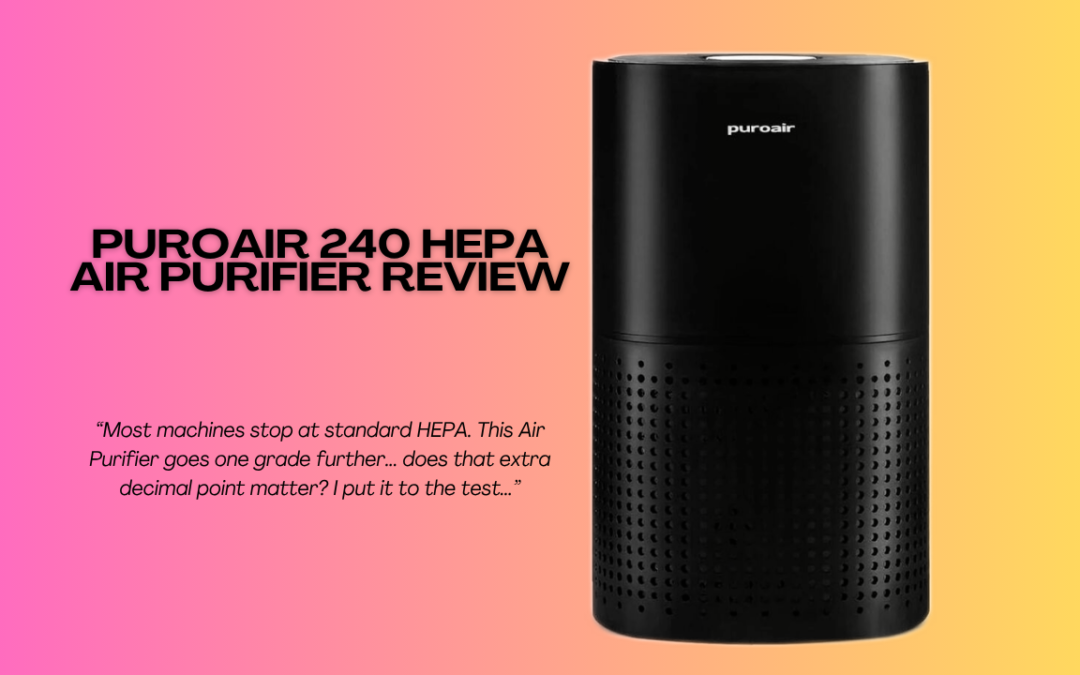
PuroAir 240 HEPA Air Purifier Review
When Standard Filtration Is Not Quite Enough
The PuroAir 240 HEPA Air Purifier exists for allergy sufferers that standard machines quietly fail. Let me explain who I mean. Some people buy a decent purifier, run it faithfully, and still wake up congested. In fact, their triggers sit among the very finest airborne particles: smoke fragments, fine pollen debris, and the smallest dander flakes. Standard HEPA media catches 99.97% of particles at 0.3 microns, which sounds complete. However, the most sensitive noses react to what slips through that final gap.
The Central Argument of This Review
Now, here is the case for the PuroAir 240 in one line. This machine fits HEPA 14-grade media, targeting 99.99% of particles down to 0.1 microns, and it wraps that medical-adjacent filtration in a machine anyone can operate. That extra decimal point is the entire argument, and this review tests whether it earns the purchase. Filter grade means nothing if airflow is weak. Equally, fine filtration means nothing if the machine is too fiddly for daily life. The PuroAir claims to deliver serious media in the simplest package on the market, and I will show you where that trade succeeds and where it costs you features.
What This Review Covers
Beyond that, I will take you through the unboxing, the compact build, and every feature the machine offers, which will not take long, because simplicity is the design brief. Then comes real-world performance against dander, pollen, dust, and household smells. Also, you will get the full specifications, honest pros and cons, and a straight verdict on the price.
Meanwhile, if you want the whole field of ten rivals, this machine placed fourth in our guide to the best air purifiers for allergy sufferers, and it beat several bigger names on filtration alone.
That said, fourth overall makes it first for one buyer: the highly sensitive allergy sufferer with a single problem room. Let’s see if that is you.
First Impressions and Unboxing
Honestly, the unboxing sets modest, accurate expectations. The packaging is tidy and well padded, and the machine arrives without a mark. Inside, you find the purifier, one pre-installed three-in-one filter, and a short quick-start guide. Nothing else hides under the foam, and nothing else is needed.
First, the usual setup ritual applies. The filter ships in a plastic wrapper inside the base. Therefore, you must twist open the bottom, unwrap the filter, and reseat it before switching on. The whole job takes two minutes without tools.
Next, the physical impression is all about portability. At around 8 pounds, this is the lightest machine in our top five, and the moulded handle recess makes one-handed carrying easy. Whilst the plastic body feels simpler than premium rivals, nothing creaks or flexes. The seams are clean, and the base twists open and closed with a reassuring click.
Finally, setup speed is the fastest I have recorded. From box to running took under five minutes, with no app, no account, and no pairing. In practice, you plug it in, set the control, and walk away. For anyone whose patience for smart-home setup ran out years ago, this is bliss.
Design and Build Quality
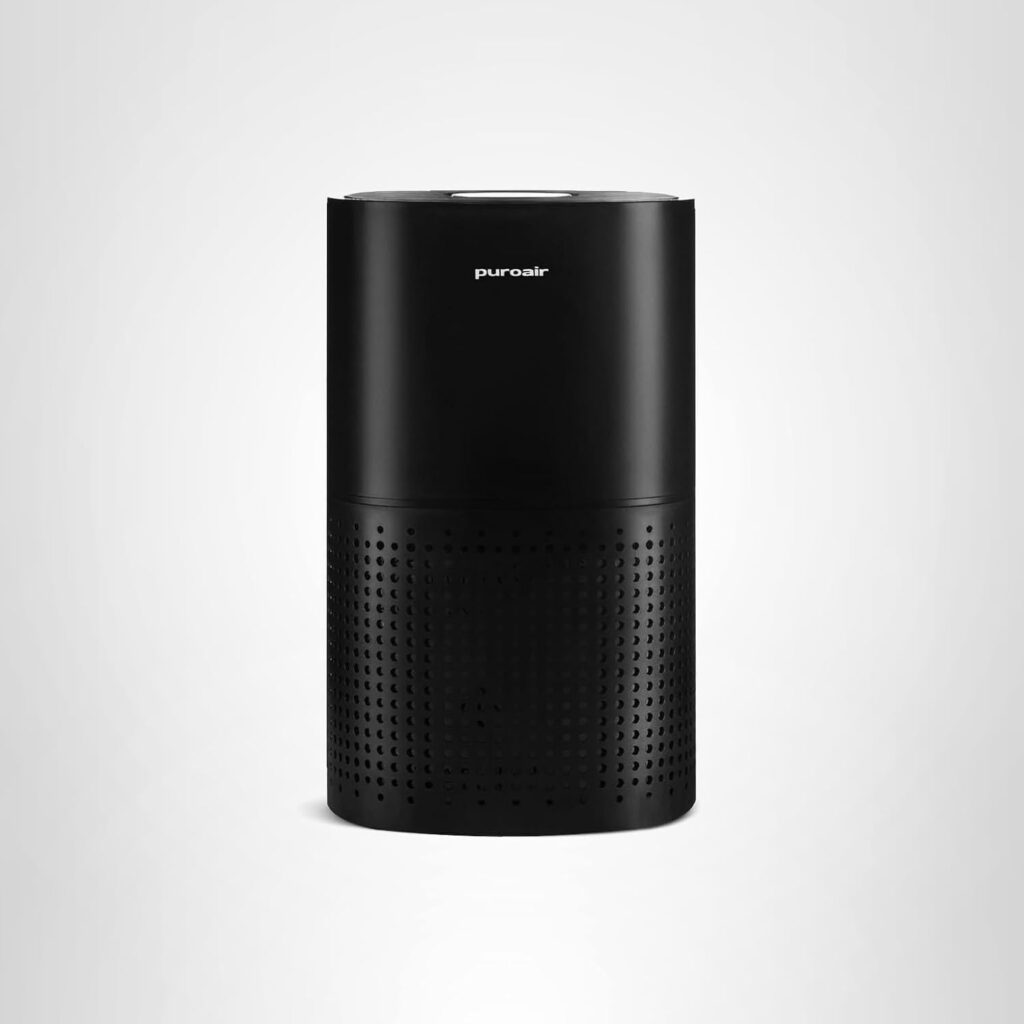
Overall, the PuroAir 240 follows the popular cylinder template: a compact tower with a 360-degree intake grille around the lower body and an upward-facing outlet on top. Air pulls in from all sides and vents towards the ceiling. Consequently, placement is forgiving, and corners work fine.
Materials are honest mid-grade plastic. In particular, the intake grille feels rigid, and the top control area uses a smooth matt finish that hides fingerprints. The overall look is clean and neutral. Whilst it lacks the fabric charm of a Blueair or the gadget polish of a Levoit, it disappears politely into any room.
Ergonomically, the lightweight is the story. Moving the machine from bedroom to lounge takes one hand and ten seconds. However, the compact size also means a smaller filter, which shortens replacement intervals compared with bigger rivals.
Durability looks solid for the class. The twist-lock base survives repeated filter changes without wearing loose, and owners report steady multi-year service. Compared with similar compact machines, the build sits comfortably mid-pack. By contrast, the Levoit Core 300-P feels slightly more refined, whilst no compact rival matches the PuroAir’s filter grade. That trade defines the whole product.
For the full rankings, see how it scored in our complete comparison of the best air purifiers for allergy sufferers.
Key Features
Now for the features, and the honest truth is that one feature towers over the rest. Here are the five that matter, plus the gaps.
HEPA 14 Grade Filtration
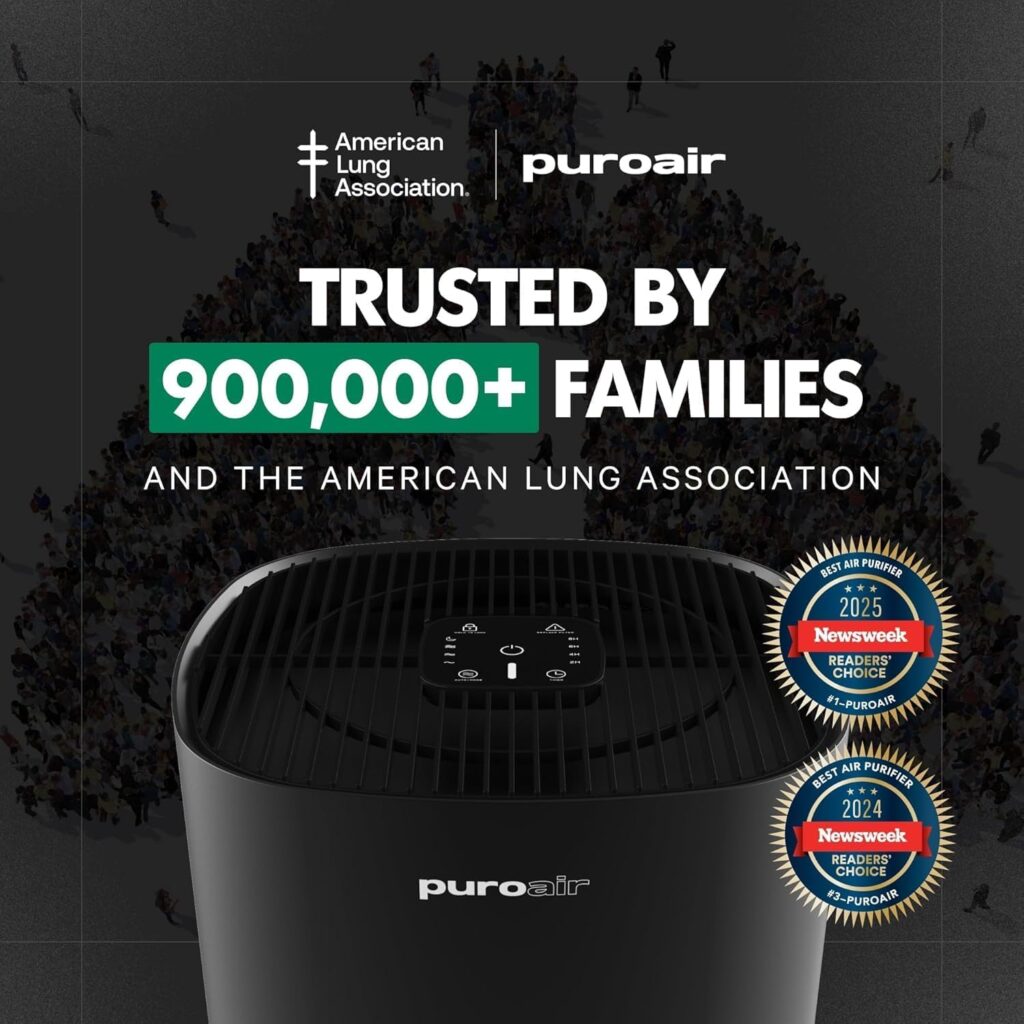
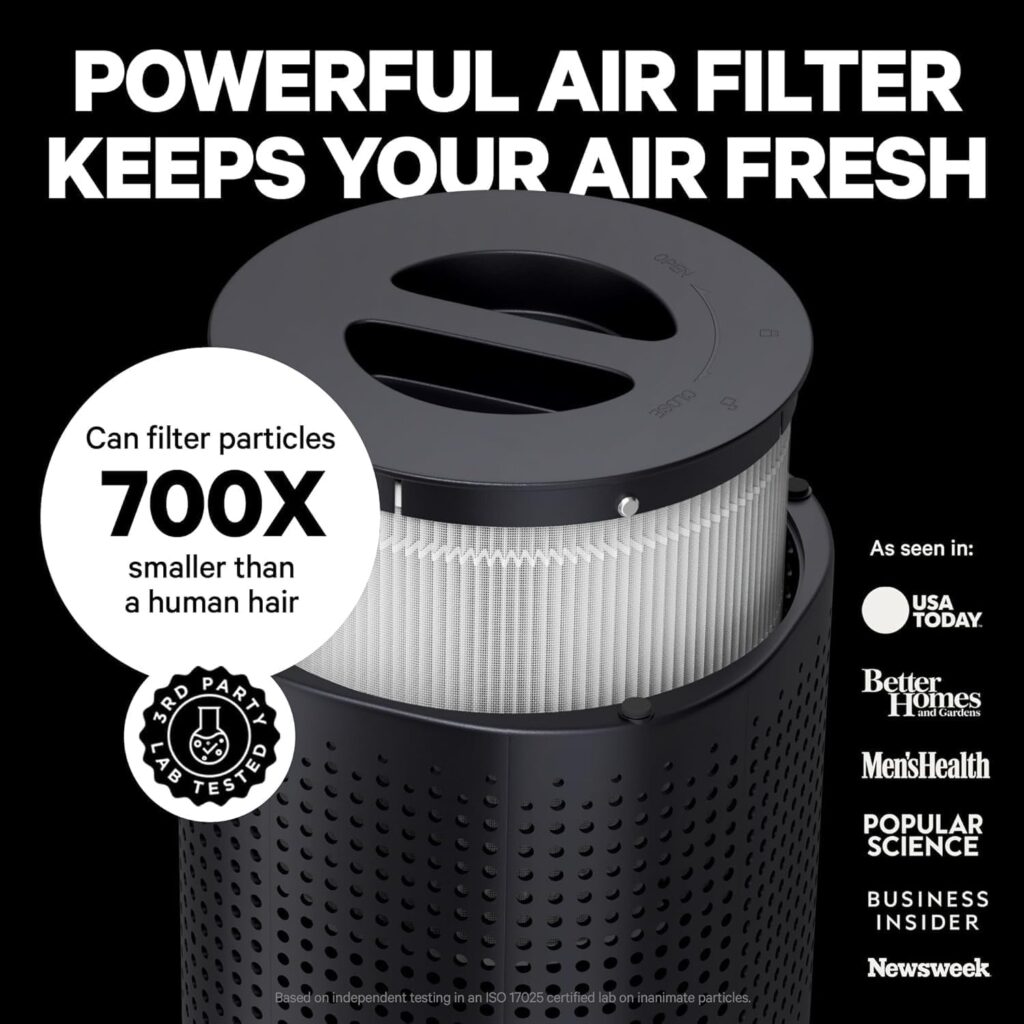
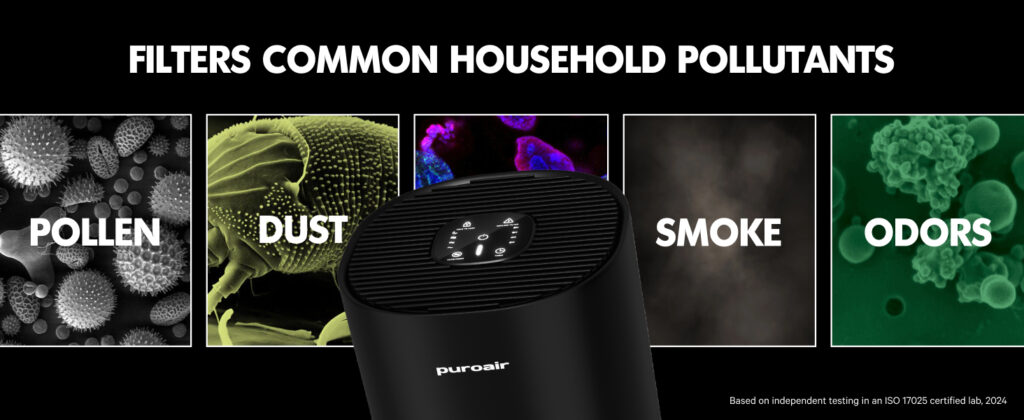
Crucially, this is the headline and the whole purchase case. The main filter uses HEPA 14 grade media, targeting 99.99% of particles down to 0.1 microns. By contrast, standard HEPA stops at 99.97% of 0.3 micron particles. In practice, the difference matters for the finest triggers: smoke fragments, fine dust, and the smallest dander particles. You can read the filtration claims in full on PuroAir’s official site. For most people, standard HEPA suffices. For the most sensitive noses, this grade is the safer bet.
Three-in-One Filter Design
Also, the filter combines three stages in one cartridge. A mesh pre-filter catches hair and lint first. Then the HEPA 14 media handles the microscopic load. Finally, an activated carbon layer absorbs odours and cooking smells. Consequently, replacement is a single simple swap rather than juggling separate parts.
Genuinely Simple Controls
Beyond that, the control scheme is refreshingly plain. A simple dial-style control covers the fan speeds and the timer, and a small light signals filter replacement time. Honestly, some buyers want fewer decisions, not more. PuroAir built exactly that machine, and older relatives master it in one minute.
Compact, Portable Build
Meanwhile, the 8-pound weight and moulded grip turn this into a follow-you-around purifier. Bedroom at night, home office by day, nursery when needed. In practice, one machine covers several rooms across a week, provided you accept it cleans one room at a time.
Quiet Low-Speed Running
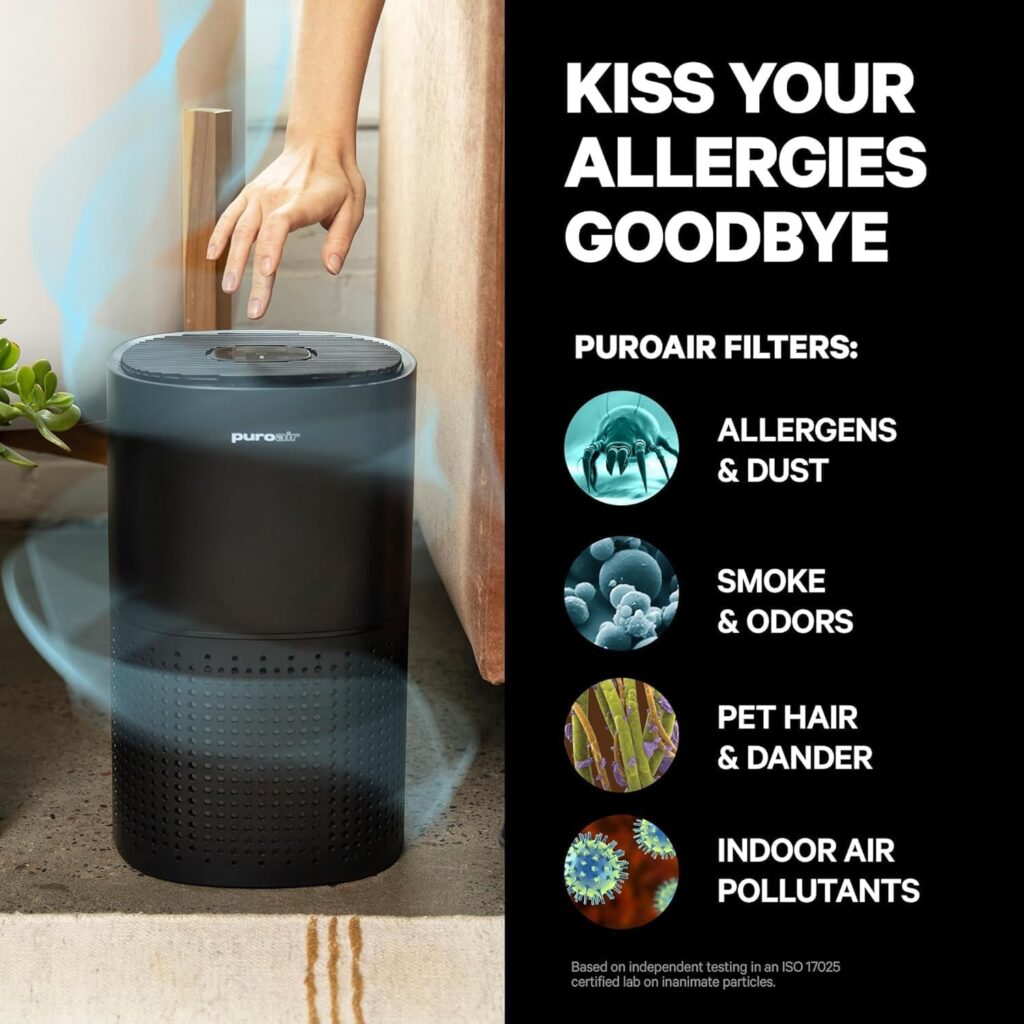
Additionally, the low setting runs at around 25 decibels, which is comfortably bedroom-safe. The top speed rises to a firm but tolerable rush. For a machine this small, the noise balance is well judged.
The Missing Features
Two absences deserve honesty. There is no particle sensor and no auto mode, so the machine never adjusts itself. Equally, there is no app or voice control. That said, every removed feature brought down the price, and the filtration budget clearly went where it matters.
For the full rankings, see how it scored in our complete comparison of the best air purifiers for allergy sufferers.
Performance and Real-World Testing
So, does the fancy filter grade show up in real rooms? Here is how the PuroAir 240 performed across the tests that matter.
Everyday Dust and Pollen
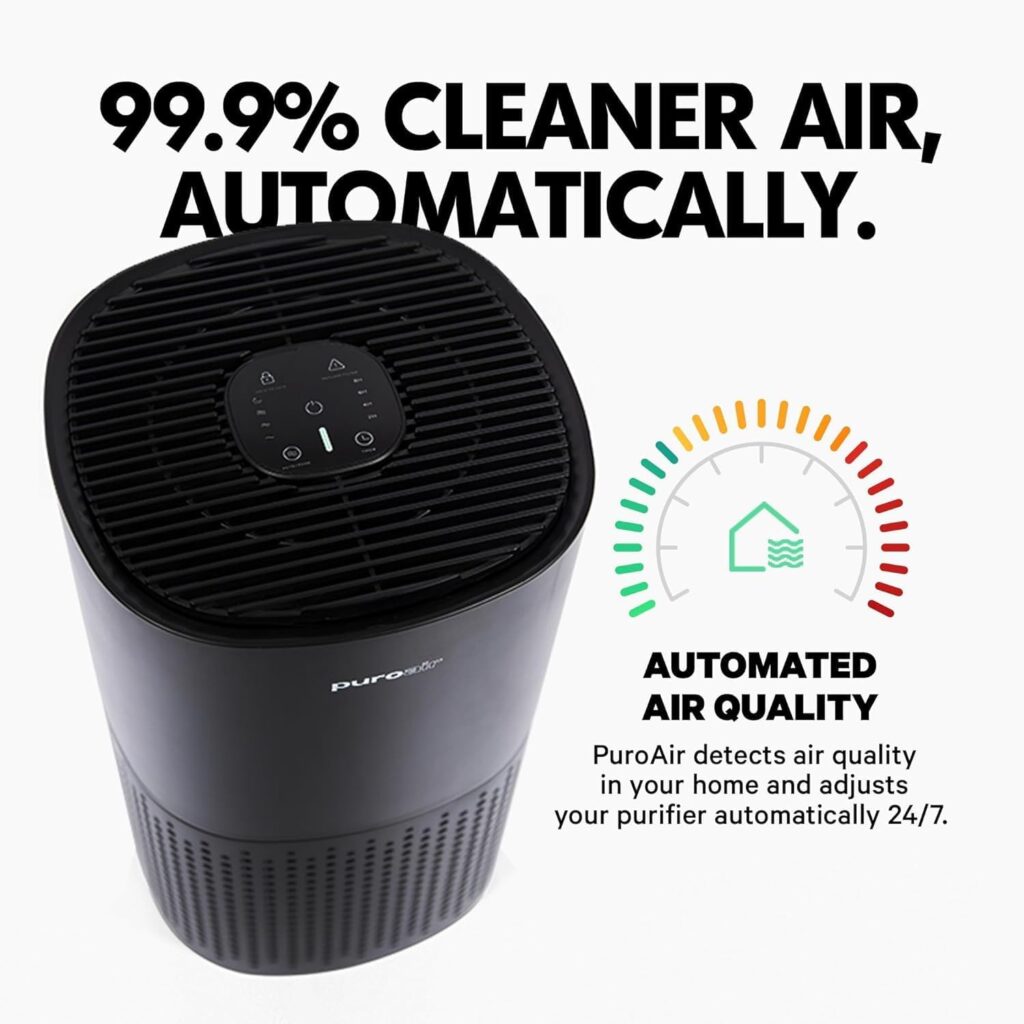
First, background duty in a medium bedroom. Running on the middle speed, the machine kept the room noticeably fresher, and settled dust build-up slowed across the week. During a pollen stress test with a window open, symptoms stayed calmer than with no machine running. However, without a sensor, the machine cannot react to spikes on its own. Consequently, you become the auto mode, nudging the speed up when the air feels heavy.
Pet Dander and Hair
Next, the pet test, which is this machine’s marketing home ground. Dander is among the finest common allergens, and the HEPA 14 media is built for exactly that particle range. In practice, a room with a resident cat stayed comfortable for a sensitive visitor across an evening. The American Kennel Club notes that dander clings to the smallest airborne particles, which is precisely where this filter grade earns its keep. Meanwhile, the mesh pre-filter collected a fair coat of hair within two weeks.
Cooking Smells and Household Odours
Also, the carbon layer performs respectably for the machine’s size. Frying smells and litter tray odours faded faster with the unit on high. That said, the carbon quantity is modest. Heavy odour households will exhaust it before the HEPA media wears out, and the combined cartridge replaces as one.
Noise and Daily Comfort
Equally, the sound profile suits its bedroom mission. Low speed is a soft hush at around 25 decibels. The middle speed blends into household background noise. By contrast, the top speed announces itself, so save it for empty-room bursts before bed.
Reliability Over Extended Use
Finally, extended running produced no drama. Airflow stayed steady, the simple control never glitched, and the filter light behaved. With so few parts to fail, there is very little to go wrong.
For the full rankings, see how it scored in our complete comparison of the best air purifiers for allergy sufferers.
Technical Specifications
| Specification | Detail |
|---|---|
| Coverage | Up to 1,000 sq ft (one air change per hour) |
| Filtration | Mesh pre-filter, HEPA 14 grade, activated carbon |
| Filter Format | Single three-in-one cartridge |
| Noise Level | Around 25 to 52 dB |
| Controls | Simple dial-style control with timer |
| Smart Features | None (no sensor, app, or auto mode) |
| Dimensions | Around 10.5 x 10.5 x 16.5 inches |
| Weight | Around 8 lbs |
| Filter Life | Around 4 to 6 months |
| Warranty | Around 2 years |
In plain language, treat the coverage claim honestly. At the four to five air changes per hour that shift allergy symptoms, this machine suits rooms around 200 to 250 square feet. Consequently, bedrooms, studies, and nurseries sit in its sweet spot, not open lounges.
Accessories and Tools Included
Honestly, the accessory list is short by design. You receive the purifier, the pre-installed three-in-one cartridge, and the quick-start guide.
The single-cartridge format is the practical highlight. Replacement takes under two minutes: twist the base, swap the cartridge, twist it closed. Additionally, PuroAir sells the cartridges in multi-packs, which trims the per-filter cost usefully.
One planning note: the 4 to 6 month filter life runs shorter than the 12 months bigger machines manage. Therefore, buy a spare cartridge with the machine, and the filter light will never catch you unprotected.
Pros and Cons
Pros
- Highest filter grade in its class. Indeed, HEPA 14 media targets the ultra-fine particles standard filters miss.
- Effortless operation. Consequently, anyone from teenagers to grandparents runs it without instructions.
- Light and portable. So one machine can serve several rooms across the week.
- Fast, tool-free filter swaps. As a result, maintenance never gets postponed.
- Quiet bedroom-safe low speed. Meanwhile, around 25 decibels disturbs nobody overnight.
- Sensible price for the media grade. Equally, no rival offers this filtration for similar money.
Cons
- No sensor or auto mode. However, manual control suits a single settled room well enough.
- Shorter filter life than large machines. That said, multi-packs soften the cost.
- Modest carbon capacity. Even so, everyday household odours are handled fine.
- No smart features whatsoever. In practice, that is a choice, not an oversight.
For the full rankings, see how it scored in our complete comparison of the best air purifiers for allergy sufferers.
Who This Product Is Best For
The Highly Sensitive Allergy Sufferer
First, the headline profile. If standard HEPA machines have left you still sniffing, the finer media grade here is the logical next step. Consequently, people who react to smoke, fine dust, and the smallest dander fragments get the most from this machine. One problem room, one serious filter, job done.
The Simplicity-First Buyer
Next, anyone allergic to apps as well as pollen. There is nothing to pair, update, or troubleshoot. Also, the dial-style control makes this the easiest gift purifier on the market. Buying for a parent or grandparent? This is the one.
The Multi-Room Mover
Equally, the light build suits people who want one machine following them around a flat. Bedroom overnight, office by day. Testing by the Good Housekeeping Institute has long favoured purifiers that people actually keep using, and portability quietly drives that habit.
Who Should Look Elsewhere
By contrast, large open-plan spaces overwhelm this machine, and the Levoit Core 600S-P covers triple the area. Similarly, buyers who want auto mode and air quality readouts should look at the sensor-equipped Levoit and Winix machines. Finally, heavy-odour households need more carbon than this compact cartridge carries.
Alternative Uses and Versatility
Beyond its bedroom mission, the PuroAir 240 stretches into some useful corners. The fine filtration makes it a strong nursery machine, where the simple controls also mean no accidental setting changes. Also, home offices benefit from the quiet low speed during calls and focused work.
Meanwhile, hay fever season turns the portability into a feature. Carry it to whichever room you occupy, and your personal air bubble follows. On top of that, the HEPA 14 media makes it a sensible companion for craft rooms and small workshops, where fine dust hangs in the air. Finally, students in small rented rooms get serious filtration in a package that moves house easily at the end of term.
Value for Money and Comparison
Now for the money question. The PuroAir 240 sits in the budget-to-mid tier, and the value equation is unusual. So what does the price buy? In real terms, you get the finest filter media on our whole list, wrapped in the simplest machine, with every convenience feature stripped out to pay for it.
Against the Levoit Core 300-P, the PuroAir trades a touch of polish and cheaper filters for the superior media grade. Against the Levoit Vital 100S-P, it trades sensors and app control for that same filtration edge. By contrast, the Winix 5510 offers far more machine overall, but at a higher price and without the HEPA 14 grade.
Long term, the shorter filter life is the honest cost. 4 to 6 months per cartridge adds up faster than the 12-month cycles of bigger rivals. Therefore, budget for 2 to 3 cartridges per year and judge the total accordingly.
For the full rankings, see how it scored in our complete comparison of the best air purifiers for allergy sufferers.
Honestly, for sensitive noses treating one room, the price is well justified. For everyone else, cheaper standard-HEPA machines cover the need.
Maintenance and Long-Term Ownership
The Day-to-Day Routine
In practice, daily care amounts to nothing beyond using it. Weekly, give the intake grille a quick wipe so dust never builds into the vents. Also, glance at the filter light now and then, though it will announce itself when the time comes.
Filter Care Schedule
Monthly, run a vacuum nozzle gently over the pre-filter mesh through the intake grille. Consequently, hair and lint clear before they choke airflow. The full cartridge swap lands every four to six months. Crucially, the HEPA 14 media cannot be washed or vacuumed back to health. When it is done, replace it, because a clogged fine filter strangles the airflow that delivers its benefits.
Storage, Moving, and Seasonal Habits
Beyond the filters, a few habits protect this machine’s portable lifestyle. First, when carrying it between rooms, power it down and let the fan stop, since moving a spinning unit stresses the bearings for no reason. Also, if it goes into a wardrobe or cupboard over summer, run it for ten minutes first to clear the media, then bag it loosely to keep dust off the intake. In particular, never store it with a heavily loaded filter, because trapped odours settle into the machine itself. Then, before hay fever season, fit a fresh cartridge so the HEPA 14 media meets the pollen surge at full strength. Finally, wipe the outlet grille whenever you move it, and the airflow stays honest year-round.
Parts, Costs, and Common Issues
Replacement cartridges are easy to find, and multi-packs cut the unit cost. Owner complaints are few and small. The most common notes are the wrapped-filter setup step and surprise at the shorter filter life. Expected lifespan sits comfortably in the four to five year range, and the warranty covers the early period. With no motors beyond the fan and no electronics beyond the control, longevity mostly takes care of itself.
Reasons to Buy
- Your triggers are the finest particles. So the HEPA 14 grade targets exactly what standard filters miss.
- You want zero learning curve. Consequently, the dial-style control removes every decision.
- You need one machine for several rooms. Indeed, the 8-pound build follows you anywhere.
- You are buying for an older relative. As a result, simplicity becomes the main feature.
- Quiet night running matters. Meanwhile, the 25 decibel low speed stays bedroom-safe.
- Your budget is real, but your allergies are serious. Equally, no rival sells this media grade for similar money.
Reasons to Skip
- Your space is large or open-plan. Therefore, the Levoit Core 600S-P covers triple the area properly.
- You want the machine to manage itself. By contrast, sensor-equipped rivals adjust all day automatically.
- Odours are your main enemy. In that case, the Winix 5510 carries far more carbon capacity.
- You hate frequent filter purchases. However, remember multi-packs soften that cost usefully.
Conclusion
The Verdict
So, back to the central argument. The PuroAir 240 promised medical-adjacent HEPA 14 filtration in the simplest possible package, and it delivers exactly that. The media grade genuinely targets the ultra-fine particles that standard machines let through, and the stripped-back design keeps the price honest. Consequently, this is a specialist tool rather than an all-rounder. The missing sensor, absent app, and shorter filter life are real costs. None of them touches the core case for the buyer this machine was built for.
Who Should Buy It
Overall, buy the PuroAir 240 if you are a sensitive allergy sufferer treating one main room and you want the finest filtration available at a sane price. Equally, it is the best gift purifier on our list, since anyone can run it from minute one. However, skip it if you need coverage, automation, or heavy odour control, where the Levoit Core 600S-P stands as the strongest alternative and our overall winner for whole-floor homes.
Final Advice and Next Steps
First, be honest about your room size, because this machine shines at 200 to 250 square feet and fades beyond that. Next, order a spare cartridge with the machine, so the 4 to 6 month filter cycle never catches you out. Then place it with clear space around the intake and let it run daily, since steady operation beats occasional bursts every time.
Finally, compare it against the whole field in our top-rated picks for allergy sufferers before committing.
For the sensitive nose with one stubborn room, the PuroAir 240 HEPA Air Purifier is the sharpest specialist on the list, and that extra decimal point of filtration is exactly why it belongs there.
Related reviews: Levoit Core 600S-P Smart Air Purifier Review | WINIX 5510 Air Purifier Review